If your knee is still stiff after surgery, despite all your hard work with physiotherapy, your surgeon may mention a manipulation under anaesthesia, often shortened to MUA. Hearing that you might need another procedure can be worrying, especially when you have already been through so much. Although MUA can help some patients, it is not a guaranteed or risk-free solution. Understanding the risks, the likelihood of a lasting improvement and the rehabilitation required afterwards can help you make an informed decision.
In this article we'll explain in plain English what an MUA is, why a surgeon might suggest one, what the day usually involves and what happens afterwards. We'll also share some questions you may wish to ask your surgeon, so you can make the decision that feels right for you.
What is manipulation under anaesthesia?
A manipulation under anaesthesia is a procedure in which your surgeon moves your knee through its range of movement while you are under an anaesthetic. While you are anaesthetised, the surgeon applies controlled force to bend and straighten the knee, aiming to release scar tissue and improve movement. Unlike stretching while awake, you cannot adjust the intensity of that force during the procedure.
No cuts are made. You may also hear it called a "manipulation under anaesthetic"; both mean the same thing.
However, MUA is still a medical procedure. Pain, swelling and a return of stiffness can occur, and some people do not achieve the movement they hoped for. Less common complications include a fracture, tendon injury or bleeding into the knee. Your surgeon can explain the risks relevant to your knee.
Why might a surgeon suggest an MUA?
After knee surgery, the body lays down scar tissue as part of normal healing. In some people this becomes excessive and tight, a condition called arthrofibrosis, which our guide to Arthrofibrosis of the Knee explains. The knee may stop bending or straightening any further, even with regular physiotherapy.
Your surgeon may talk to you about an MUA if:
- your knee isn't bending or straightening as much as expected at this stage of your recovery
- your progress has levelled off, even though you've kept up with your exercises
- stiffness is making everyday things like stairs, sitting in a chair or getting in and out of a car difficult
Every knee is different, and the decision depends on your surgery, your recovery so far and your surgeon's assessment. Being offered an MUA is not a sign that you've done anything wrong.
What the day usually involves
Hospitals do things in different ways, and your team will give you their own instructions. Many people find it helps to know roughly what to expect:
- Before: as with any anaesthetic, you'll be asked not to eat or drink for a while beforehand.
- The anaesthetic: this may be a general anaesthetic or a spinal or nerve block. Your anaesthetist will talk you through the options.
- The manipulation: your surgeon moves the knee carefully while you're under the anaesthetic.
- Waking up: your knee is likely to feel sore and swollen. Your team will make sure you have pain relief so you can start moving it again.
- Going home: your team will tell you whether to expect to go home the same day or stay overnight.
What happens afterwards
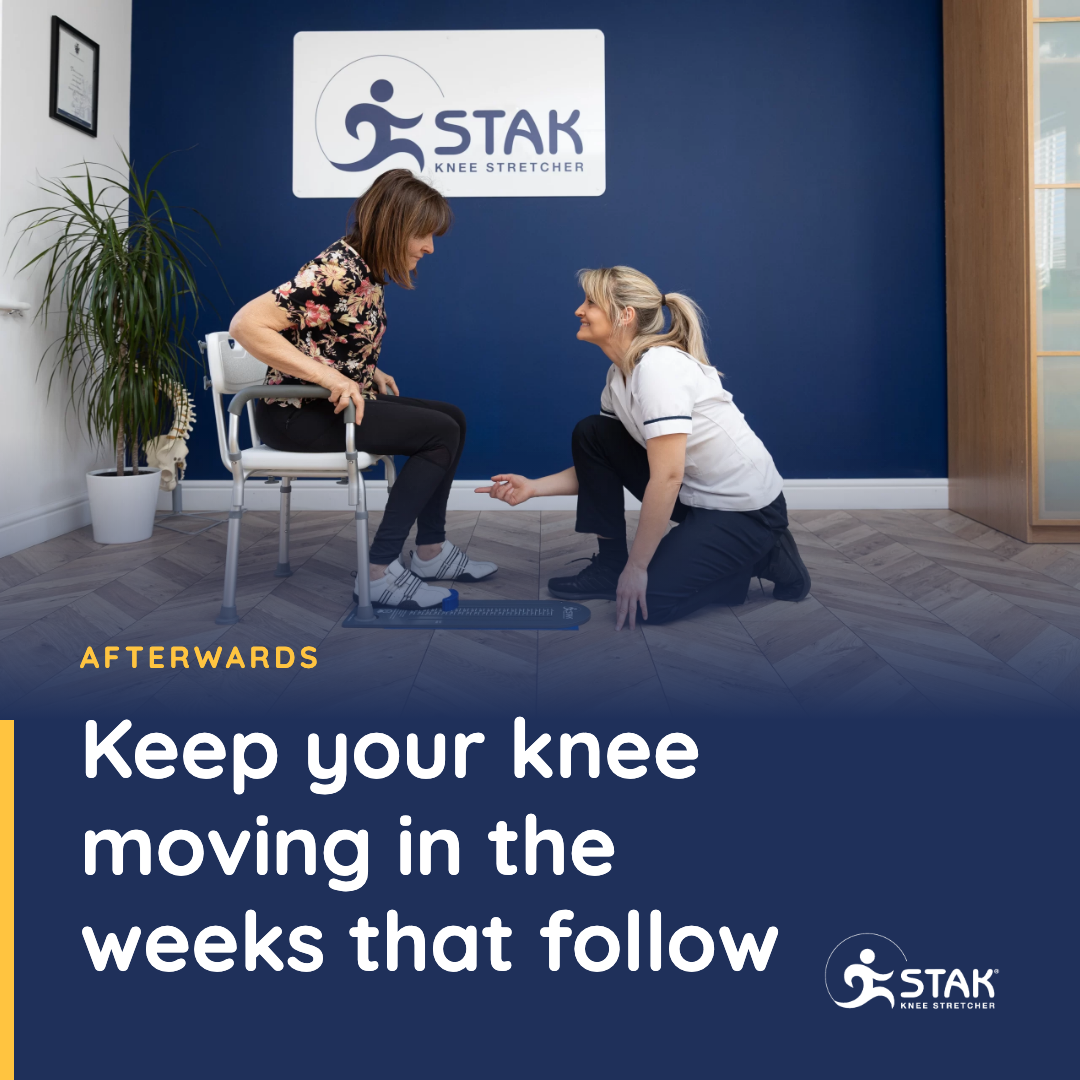
The MUA itself is only part of the treatment. What happens in the following days and weeks is crucial. Pain, swelling and re-stiffening can make it difficult to maintain any movement gained during MUA, so a structured programme of daily, effective stretching (including high-intensity stretching where appropriate) alongside physiotherapy is essential.
- Start moving early. Most teams want you bending and straightening your knee very soon afterwards. Some hospitals also use a machine that moves the knee for you while you rest.
- Keep up with your physiotherapy. Your physiotherapist will give you a plan, which usually includes stretching several times a day.
- Take your pain relief before you stretch, as your team advises, so that you can stretch more comfortably.
- Keep swelling under control with elevation and cold therapy. Our guide to swelling after knee replacement explains how.
- Work on straightening as well as bending. Our guide to Knee Flexion vs Extension explains why both matter.
Goal: keep your knee moving, so the scar tissue has less chance to tighten again.
Questions you may wish to ask your surgeon
It can be hard to remember everything in an appointment, so it's worth writing your questions down beforehand. You might like to ask:
- Why do you think an MUA is right for my knee at this stage?
- Before an MUA, could I try a structured programme of progressive home stretching? What are the risks and benefits of each approach for my knee?
- What kind of anaesthetic will I have?
- Will I go home the same day?
- What will my physiotherapy look like afterwards, and how soon will it start?
- How will we know whether it has helped, and what happens if my knee stiffens again?
- Is there anything I can do now to prepare?
Are there alternatives to MUA?
An MUA is one of several ways of treating a stiff knee. Depending on your situation, your team may also talk to you about:
- more intensive or more frequent physiotherapy
- regular stretching at home between sessions
- pain relief or anti-inflammatory medication, so you can stretch more comfortably
- keyhole or open surgery to release scar tissue (arthrolysis), which is usually considered only when other approaches haven't helped
Our article on Arthrofibrosis Knee Treatment & Recovery covers these in more detail.
Where the STAK Knee Stretcher fits
Regular stretching at home is part of most plans for a stiff knee. The STAK Knee Stretcher offers a non-surgical option to discuss before proceeding to MUA. It enables regular, progressive, high-intensity stretching at home using the patient's own leverage. Crucially, you remain awake and in control of the stretch: you can adjust the intensity, ease off or stop as needed. Repeated stretching progressively stretches tight tissues over time, rather than relying on one procedure. Being able to see and feel progress can also be highly motivating.
The STAK may also be valuable after an MUA. If your surgeon agrees it is appropriate, consistent home stretching can help you work towards maintaining and building on the movement gained, including where previous physiotherapy or an MUA has not achieved the hoped-for result. The STAK complements physiotherapy as part of a rehabilitation programme guided by clinical assessment.
In a published study of 35 patients with knee stiffness after major surgery, those using STAK alongside physiotherapy gained an average of 30° of movement over eight weeks, compared with 8° in the standard physiotherapy group. In the 35-patient study, 96% of participants found the STAK acceptable. At Royal Devon and Exeter, clinicians have also reported that MUA procedures more than halved following adoption of a STAK-supported pathway, alongside improved patient satisfaction. At University Hospitals of Leicester, consultant knee surgeon Mr Steven Godsiff has reported that his team stopped performing MUA following the introduction of STAK.
When to seek help
After an MUA, contact your surgical team, GP or NHS 111 if:
- your pain is getting worse rather than better, despite taking your pain relief
- your knee becomes red, hot or more swollen, or you feel feverish or unwell
- you notice pain, swelling, warmth or tenderness in your calf
- pain is stopping you from keeping up with your exercises
Call 999 if you have sudden breathlessness or chest pain. These can be signs of a blood clot and need urgent treatment.
Final Thoughts
If you have been offered an MUA, ask about the potential benefits, risks and alternatives, including whether intensive, progressive home stretching could be appropriate for you. And if you have already undergone an MUA, there may still be ways to improve or maintain your movement through a consistent rehabilitation programme.
If you'd like to talk about your knee, before or after an MUA, we're always happy to help.