Almost everyone has some swelling after a knee replacement. It is a normal part of healing, but it can also be one of the most frustrating parts of recovery, because a swollen knee is often a stiff knee. When the joint is full of fluid, it simply has less room to bend.
In this article we'll look at why your knee swells, why that matters for getting your movement back, and the practical steps most people find help. We'll also cover the signs that mean it's time to contact your surgical team.
Why does my knee swell after surgery?
Swelling is your body's natural response to surgery. During a knee replacement, the tissues around the joint are cut, moved and repaired, and afterwards the body sends extra fluid and cells to the area to start healing.
That response is useful, but too much swelling, or swelling that hangs around, can get in the way of your recovery. It is common for swelling to come and go for a while, often building up later in the day or after you have been more active, and settling again with rest and elevation.
Why swelling makes it harder to bend your knee
There are a few reasons a swollen knee is harder to move:
- Less space in the joint. Fluid in and around the knee takes up room, which physically limits how far it can bend and straighten.
- More pain. Swollen tissues are tender, and pain makes it harder to do your exercises properly.
- Harder-to-switch-on thigh muscles. Swelling inside the knee can make it more difficult for the quadriceps (the large muscle at the front of your thigh) to work, which makes straightening your knee and walking harder.
💡 Did you know? Swelling and stiffness feed each other. A stiff knee moves less, and a knee that moves less tends to hold on to swelling. Keeping swelling under control gives your stretching and exercises the best chance of working.
That is why we think of managing swelling as part of getting your bend back, not something separate from it.
Top 5 Tips for Managing Swelling After Knee Replacement
1. Elevate your leg properly
Elevation helps fluid drain away from the knee. To get the most from it, your ankle should be higher than your knee, and your knee higher than your hip. Lying down works far better than sitting in a chair with your foot on a stool.
- Lie on your back with your whole leg supported on pillows along its length.
- Keep your knee as straight as is comfortable. A pillow just under the knee feels comfortable, but resting with the knee bent can make it harder to straighten.
- Build regular elevation breaks into your day, especially after activity.
Goal: Short, regular spells of proper elevation throughout the day.
2. Use cold therapy as your team advises
Cold can help ease swelling and pain. You might use an ice pack, a bag of frozen peas or a cold therapy device, always wrapped in a damp towel and never directly on the skin. Your surgical team or physiotherapist will tell you how often and for how long, so it is worth following their advice and checking your skin regularly.
Tip: Many people find cold therapy fits naturally straight after their exercises, while the leg is elevated.
3. Keep moving, little and often
It can be tempting to rest completely when your knee is swollen, but gentle movement helps your circulation and encourages fluid to move out of the leg.
- Ankle pumps: point your toes up and down briskly while lying or sitting.
- Thigh tightening: press the back of your knee down towards the bed, hold, then relax.
- Short walks: regular short walks around the house, rather than one long one.
Goal: Movement spread through the day, with rest and elevation in between.
4. Pace your activity
Swelling is often a sign that you have done a little too much. If your knee is noticeably more swollen in the evening or the following day, it may be worth scaling back slightly and building up more gradually. Pacing is not about doing less overall; it is about spreading your activity so your knee can keep up.
5. Take pain relief before you exercise
Pain and swelling go hand in hand. Taking your prescribed pain relief before your exercises and stretches, rather than waiting until it hurts, means you can move more comfortably and get more out of each session. If you're not sure how best to time your medication, your pharmacist, GP or surgical team can help. If you have been given compression stockings, wear them as advised.
Where the STAK Knee Stretcher fits
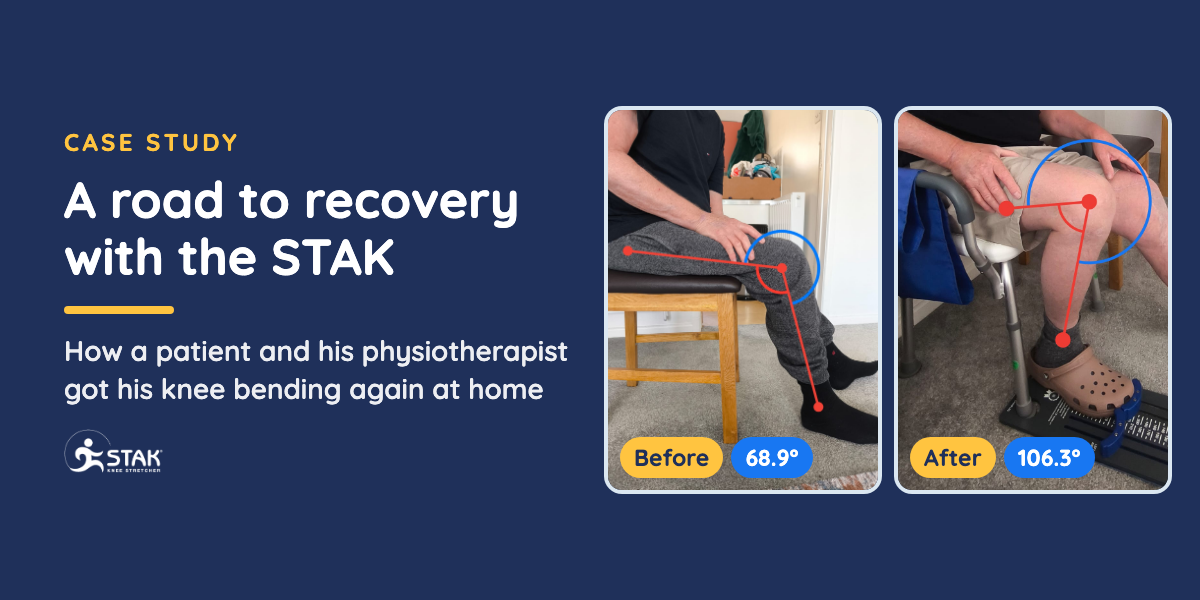
Once swelling is under control, regular stretching becomes much easier. For people whose knee is stiff and slow to bend, the STAK Knee Stretcher allows high-intensity stretching at home, alongside a physiotherapy programme. It can help to follow a stretching session with elevation and cold therapy, so the knee settles afterwards.
For more on building a balanced routine, see our Knee Replacement Recovery Tips and our guide to Knee Flexion vs Extension.
When to seek help
Some swelling is expected after a knee replacement. Contact your surgical team, GP or NHS 111 promptly if you notice:
- Swelling that suddenly gets much worse, or that is getting worse rather than better
- Pain, swelling, warmth or tenderness in your calf
- Redness, heat or discharge from your wound, or you feel feverish or unwell
- Your knee becoming steadily stiffer despite your exercises
Call 999 if you have sudden breathlessness or chest pain. These can be signs of a blood clot and need urgent treatment.
If your knee is stiff and not improving, our article on arthrofibrosis knee treatment explains the options and why acting early matters.
Final Thoughts
Swelling after a knee replacement is normal, and it is also something you can do a lot about. Proper elevation, cold therapy, gentle movement, pacing and well-timed pain relief all help keep swelling under control, and give your exercises and stretching the best chance of working.
If you are worried about swelling or stiffness, you don't have to manage it on your own. Your physiotherapist is a good first port of call, and we're always happy to talk about your knee.