Please note that our office will be closed from Friday 15 October and will reopen on Monday 26 October 2026.
Any new orders for the STAK tool will be shipped when we re-open.
Please note that our office will be closed from Friday 15 October and will reopen on Monday 26 October 2026.
Any new orders for the STAK tool will be shipped when we re-open.
Stiff post-op knees can drain your time, your clinic slots and your patient’s motivation – STAK helps you turn those same cases into clear wins.
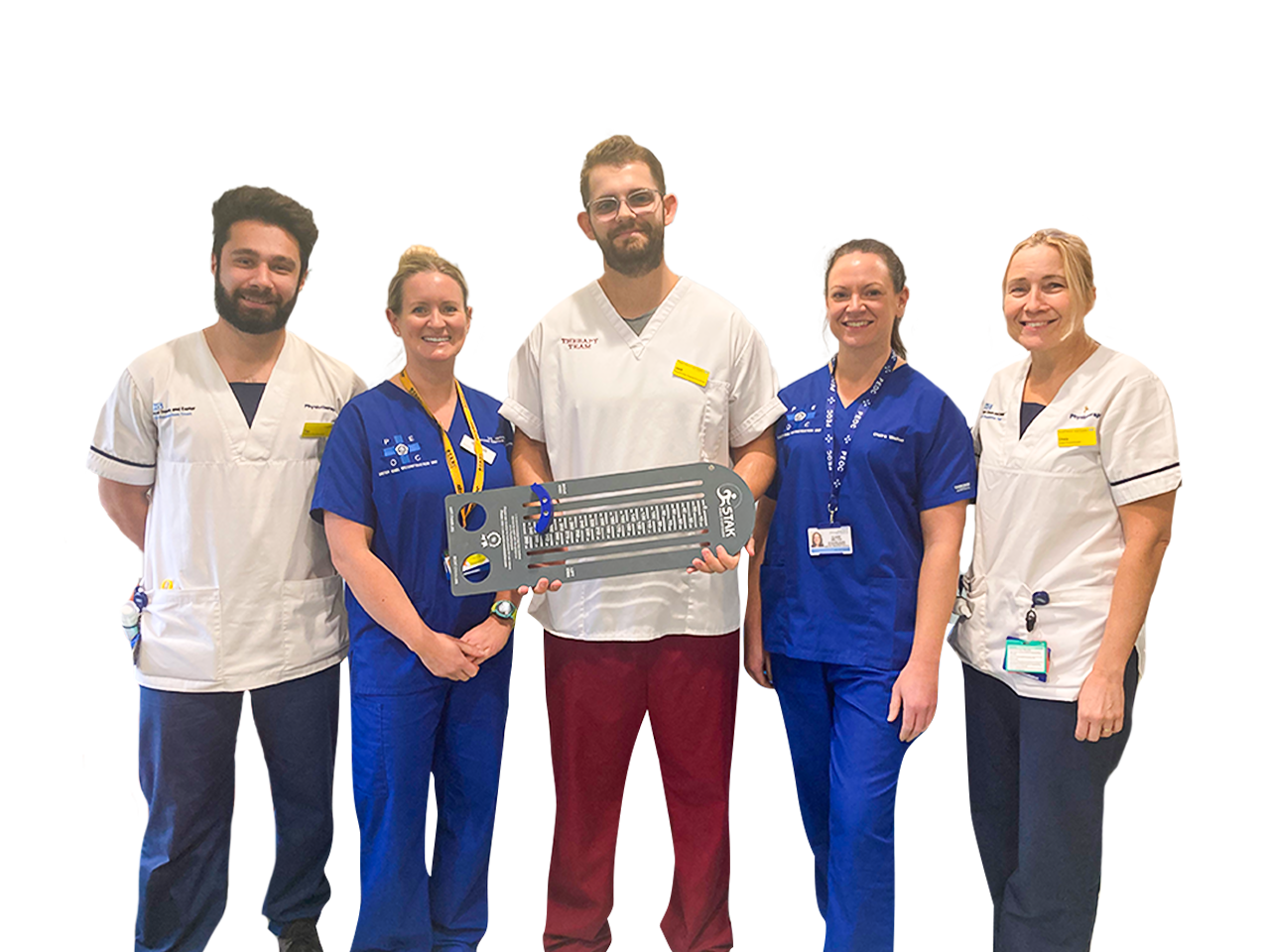
Recovering from knee surgery can be a long and frustrating journey, but the STAK tool is here to make it easier. I first discovered the STAK at a conference, and since then, it’s been a game-changer for treating knee stiffness, especially for those who’ve had knee replacements or suffer from arthrofibrosis.
For patients dealing with knee pain, whether from surgery or injury, finding a solution that extends beyond in-clinic sessions is crucial. That’s where STAK comes in.
Knee stiffness can affect a wide range of patients – from those recovering from a recent knee replacement to individuals struggling years after surgery.
Before the STAK tool came along, treating knee stiffness was a constant uphill battle. Physios could work intensely with a patient during a session.
An older lady, 18 months post-total knee replacement, came to us with a limited range of motion. She was struggling at just 75-76 degrees of flexion.
While the STAK tool works wonders on its own, the expertise of a physiotherapist takes the recovery process to the next level. The physiotherapist is there to guide patients through the programme
In this chapter, we discuss how the STAK tool doesn’t just benefit patients. It is also a powerful resource for physiotherapists.
As a physiotherapist, I strongly encourage you to bring the STAK tool into your clinic. Not only does it make a significant difference in patient outcomes
A great physiotherapy experience goes beyond just using the right tools like the STAK. It’s about building trust, providing support, and offering guidance throughout the recovery journey.
UP TO 60° RANGE OF MOVEMENT GAIN
weeks programme
VERY SATISFIED WITH TREATMENT